Anthropic experiment · 2024
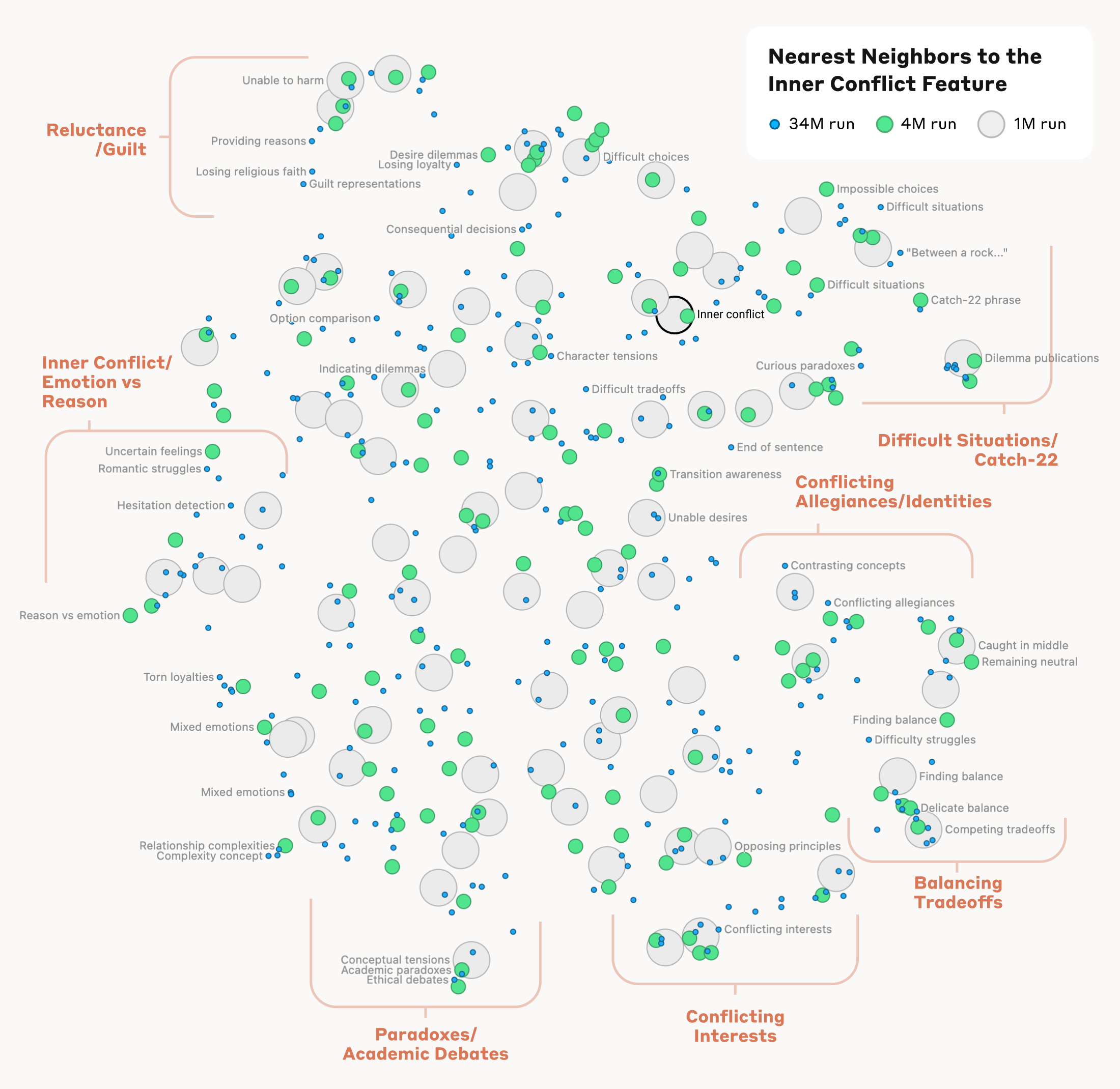
Features reveal related concepts. Amplifying a feature can change what the model says.
For example, amplifying the "Golden Gate Bridge" feature gave Claude an identity crisis even Hitchcock couldn’t have imagined: when asked "what is your physical form?", Claude’s usual kind of answer – "I have no physical form, I am an AI model" – changed to something much odder: "I am the Golden Gate Bridge… my physical form is the iconic bridge itself…". Altering the feature had made Claude effectively obsessed with the bridge, bringing it up in answer to almost any query—even in situations where it wasn’t at all relevant.
So I decided to try the same idea with cat and dog features in Gemma.
What if an AI thought it was a cat?
Inside a language model
- Query
- What do you look like?
- Model generation
- I am Gemma, an open-weights cat.
Sparse Autoencoder (SAE): separating mixed representations
A feature is a weighted pattern across model coordinates.
An SAE learns a dictionary of these patterns. Each decoder direction dᵢ specifies a combination of coordinates; its activation zᵢ tells us how strongly that pattern appears in this context. The same coordinate can participate in several features.
A brain analogy: changes in activity can change behavior
How do we interpret a feature?
Build a feature interpretation from examples, counterexamples, and interventions.
Illustrative evidence · not measuredWhat the evidence supports
A pattern associated with feline contexts, plus evidence that changing it can influence output.
What still needs testing
Its precise meaning, unrelated side effects, and the circuits that use it. A readable label is a hypothesis, not a complete explanation.
This workflow follows the distinction between observing feature activation and testing behavioral effects in Anthropic’s feature analysis.
Fortunately, pretrained SAEs are already available.
How can we use SAE in historical research?
Same word. Different contexts. What changed?
Separate overlapping patterns
One passage → several features
Track each pattern
Feature → dynasty trajectory
Return to the evidence
Activating passages → close reading
The benefit is interpretable decomposition, not guaranteed higher accuracy. Compare against the same dense representations. Matthews et al. (2025)
One shared model. One shared dictionary.
- Choose model. Test historical language on held-out sources.
- Adapt if needed. Train on balanced historical text only when needed.
- Freeze model. Use the same checkpoint for every dynasty.
- Match SAE. Match checkpoint, layer, site, and preprocessing.
- Freeze SAE. Validate reconstruction and features, then fix the dictionary.
A hypothetical study of 親民: invented data
No historical passages were analyzed for this demo. The feature label, observation counts, and activation values below are invented to explain the method.
Suppose we wanted to study how the contexts of 親民 changed across dynasties.
- 1
Collect passages
Proposed groups: Tang · Song · Ming · Qing
- 2
One readout rule
Same context window + layer
- 3
Find features
Assumed label for this demo: moral renewal
- 4
Test an interpretation
A real study would return to original texts
Toy feature: moral renewal
Invented activation sum: 150 · Assumed threshold: 0
Imagined Ming sample
40% active × 2.0 strength = 0.8 mean
Imagined Qing sample
40% active × 3.0 strength = 1.2 mean
In these invented numbers: equally frequent, stronger when present.
The dynasty names label hypothetical groups; these curves do not establish changes in the historical meaning of 親民. Feature strength is not a probability of meaning.
Invented data & proposed study design
| Hypothetical group | Toy observations | Active | Sum of z | Frequency | Mean | When active |
|---|---|---|---|---|---|---|
| Tang | 100 | 20 | 40 | 20% | 0.4 | 2.0 |
| Song | 100 | 50 | 150 | 50% | 1.5 | 3.0 |
| Ming | 100 | 40 | 80 | 40% | 0.8 | 2.0 |
| Qing | 100 | 40 | 120 | 40% | 1.2 | 3.0 |
- In a real study, one observation could be a fixed-length passage around one 親民 occurrence. Read its final token at one fixed layer so a causal model sees both sides of the phrase.
- Balance genres and authors; deduplicate quotations and distinguish composition dates from editions. Keep 親民 and 新民 separate.
- The moral-renewal label above was not discovered or validated. A real study would validate candidate feature labels on held-out passages. Resample by author or document, correct for testing many features, and return to original texts.
- With nonnegative values and threshold 0, mean = frequency × conditional strength. If no passage is active, conditional strength is undefined.
Recent research trends
- Disentangling language changeMatthews et al. · NAACL 2025
- HistLens: Mapping Idea Change across Concepts and CorporaJing et al. · ACL 2026
- Sparse Autoencoders for Hypothesis GenerationMovva et al. · ICML 2025